I considered a bike ride through the landscape with Lee Friedlander’s “America by Car” as a contextual frame of reference which started as an actual journey and became an imaginary journey through the edgelands. “Edgelands are part of the gravitational field of all our larger urban areas, a texture we build up aped to escape as we hurry towards the English countryside, the distant wilderness…If we can’t see the edgelands, we can’t imagine them, or allow them any kind of imaginative life. And so they don’t really exist.” Farley and Symmonds Roberts (2011:5) Researching Friedlander’s images, I developed mine to include the bike frame and the idea of flying through the landscape referencing Lee Friedlander’s America by Car.
My images were taken during summer afternoons on journeys between home and Worksop; a distance of 20 miles by bike, using a bridge camera to show the landscape and landmarks of the edgelands referencing Friedlander’s style of topography.
Visual description of Lee Friedlander’s America by Car
Lee Friedlander exhibited 192 images from his work America by Car at The Timothy Taylor Gallery, New York (2010) which toured America and London, and also published photobook book to accompany the series of his journey through most of the American States spanning a 15 year period. Using a style described as social documentary, he used the medium of photography to record the topography of a social landscape taken from the driver’s seat of American budget hire cars showing the driver’s perspective of urban and roadside American life. According to Whitney’s Museum of Modern Art “the car and highway represent adventure, freedom and wanderlust.” (MoMA)
Most of his images show parts of the car such as the dashboard, windscreen, side
window, rear view and side mirrors and essentials such as a steering wheel. This allowed
for special effects such as foreshortening (cutting out the middle of the image) e.g.
Montana 2008 where the top of the dashboard formed a straight line at the bottom of the
notices.
Friedlander also used juxtaposition such as in Nebraska (1999) where he photographed a
herd of cows through the side window (making a natural frame) and including the leather
door panel in the shot. The viewer is left to make their own comparisons of the image
whilst the viewpoint is familiar to most travellers.
Friedlander compared the colours and textures of the natural foliage of the tree with the
man-made door panel material in Arizona 2001. This is repeated with images such as his
car’s shadow infront of a car transporter or war memorials against a door pillar.
Friedlander’s use of the super Wide Angled Hasselblad and square format gives rise to unusual perspectives which Whitney’s MoMA likened to Robert Frank’s work. The MoMA exhibition included many photographs for maximum impact and to give viewers the feeling of driving their car through the landscape. Friedlander grouped together his images in typologies such as rural, churches etc. rather than as a journey through America.
He used reflection in the mirrors to reveal a different landscape or a person (sometimes self-portrait). The limitations of using the car as a frame reveal buildings in which perspective is uncorrected that adds to the chaotic and trapped feeling. Friedlander’s images could be described as cold and static, as if the outside world is being viewed from the inside comfort of the car.
Critical writing about the series
Sean O’Hagan, writing in The Guardian (2011), suggested that Friedlander’s America by Car fits well with earlier work rejected by Harper’s Bazaar in 1964. This included images of expensive, upmarket cars for example in a field of telephones or shot through a phone booth or hidden behind a stack of tyres. Friedlander exhibited “New Documents” in 1967 at MoMA which showed his style as “social documents” – “challenging and often playful investigations of what photography could be; a slap in the face of the high seriousness of the American Landscape tradition.” Friedlander invited the viewer to question what they were seeing. O’Hagan describes Friedlander’s America by Car series as disorientating for the viewer, because of the punctuation of the window frames although the viewer sees past this to the view.
Karen Rosenburg (New York Times 2010) on the other hand, suggests that Friedlander “knows that cars are essentially illusion factories – to wit “Objects in the mirror are closer than they appear.”” (Rosenburg, 2010) She paralleled Friedlander’s work to old Hollywood road scenes with moving projected roads and stationary cars and argues that the car obstructs the picture view. Rosenburg compares Friedlander’s work to photographers such as Eugine Atget and Walker Evans with regards to the layering of images in shop windows and mirrors and use of signs. Barlow (2014) explained that Friedlander was influenced at the beginning of his career by theses masters of photography. Rosenburg argued that Friedlander’s images did not contain many contemporary images of political and social subject matter, (referencing an image which contained an “Obama Biden” bumper sticker) and so perhaps he was not interested in this subject. She also criticised his lack of inclusion of all 50 states and questioned why he did not visit them all.
Barlow (2014) biographer of Friedlander for Grove Art Online suggested Friedlander suffered from painful knees and required knee surgery whilst photographing this body of work. The question raised by some critics is that photographing from outside the car gives a different slant on subject matter. I found this series compelling as it gave a different, obstructed perspective of the landscape and the more I considered an image, the more Friedlander’s skill revealed the social landscape.
How Friedlander’s series relates to my work
Considering how to adapt this style of photography to include my bike as the vehicle, I deliberated using a gopro camera to take stills. Friedlander’s images were shot on film and can be produced to a reasonable size although pixelated gopro images could look like a modern interpretation. Better quality images with a camera I could manipulate outweighed the accessibility of the gopro; the only difficult shot to include being the front tyre view. However, working digitally, unlike Friedlander, several shots were possible to obtain the correct perspective of the bike in the landscape. Friedlander used a super wide angled Hasselblad which produced square images.
Initially, I included only the handlebars, imagining I was sitting on a bike as opposed to being in a car; however, this was limiting and ordinary and I developed a style of 3 different views of the bike to intensify the dynamics. I found the idea of foreshortening an interesting idea, and included this within a couple of images – namely Archway House (image 5) and Worksop Pumping Station (image 9). Following my tutor’s suggestion of keeping the series to a few bike views (such as through the cables, over the rear tyre and with the suspension fork to one side) made the series more cohesive. I included an action shot self-portrait on the bike, although it appears in the middle rather than at the end of the series to show that I am riding over the landscape and it continues the momentum. Friedlander used different seasons and weather conditions; mine is based over a short time span and so for cohesion, I kept to shooting in the afternoon.
My journey
The first mile took me through different housing estates in the village and onto an old
railway line (originally owned by the Great Central Railway) and ran between 2 collieries,
with a tarmac surface where a few teenagers hang out and the rider often meets dogs off
leads, changing graffiti on the bridge and desire paths people make as they take the
shortest route up and down the unstable banks rather than use the gently sloping path.
Now owned by Sustrans, a UK charity who enable “people to travel by foot, bike or public
transport for more of the journeys we make every day.” (Sustrans, 2015)
 |
| Image 1 |
The sunlight on the yellow and blue paint provided a good contrast to the bike. The curves of the cables complemented the curves on the graffiti. I explored various angles and bike parts against the wall and felt this created a strong image. As a first image, I aimed to show the mode of transport and give the viewer a sense that it was not a journey through a “picturesque” part of the country. “Graffiti is part of the visual noise of our age, in the same way as broadsheet ballads once supplied the background buzz of earlier centuries, and is perfect for the mobile gaze; the short emphatic, florid statement of name, protest or allegiance, an impression meant to be made at high speed.” (Farley and Roberts Symmonds 2011:124) Over time, the graffiti on these bridges are painted over and repainted with different names or artwork or left to fade as people move on.
 |
| Image 2 |
As I arrived at the second mile marker, the tunnel walls were covered in graffiti. This was the furthest the graffiti artists came out of the village. The more experienced mountain bikers who use this track have made a desire path to add a skills section to their journey or shave seconds off their “Strava time[1]” by cutting out the steep hairpin bend. They mount the kerb and join the rocky path which takes them to the tunnel. This image shows the sudden descent required to the tunnel along the desire path. The direction of the crank provides a leading line and the pedal is juxtaposed with the tunnel (similar to Friedlander’s foliage with door material).
Over time, sections of the railway have been moved and other tracks added. I found the idea of “desire paths” or paths of least resistance an interesting concept of planners versus people in developing the landscape. (Farley and Symmonds Roberts, 2011:24) explain this as a “”bottom up” system against the “top down” methodology of the planners.” Walking this area always reminds me of how rights of way have evolved.
The track turned alongside Rainworth Water on one side and Rufford Colliery workings on the other. Great care is taken to keep the public out and deter would be adventurers with wire (often cut) and trees strategically placed across the track to prevent the cyclist from straying onto the pit land.
 |
| Image 3 |
After a couple of miles on land owned by the Forestry Commission, (Sherwood Pines) my journey took me across Eakring Road; a sandy road, impassable by cars and now lined by large rocks in places to keep out the notorious abandoned, torched cars. It does still hold surprises – Sat Nav’s send the unknowing holiday makers along this road to Centre Parcs! Over the years, steel barriers have been removed by opportunist scrap metal merchants and again, the barrier is now large rocks.
I turned the bike round and looked back at my journey as the view was more descriptive. Does it matter that it is not a truthful representation? I think not because if I was marketing the image for the Forestry Commission, I would argue that it is more “picturesque” than looking forwards. This image uses the idea of the doorpost framing to obstruct the view.
The view of Vicar Water Country Park is dominated by the colliery headstocks (the tallest in Europe) – a listed building which locals are fighting to save from demolition and a prominent view in the area. The pond dates from the Victorian times and sits in the middle of colliery spoil heaps, now converted into a country park and popular with many different users; walkers, cyclists, horse riders and fishermen.
 |
| Image 4 |
By framing the towers between the cables, I aimed to make the headstock towers the focal point and show trail user on the periphery of the image, similar to Friedlander’s framing with the windscreen and side window.
The track passes the edge of Clipstone Colliery and into rural countryside, past a pub, across a set of traffic lights and through the grounds of Archway House, formerly a hunting lodge and now a self-catering cottage. Originally built by the 4th Duke of Portland in 1842, it was a copy of the gatehouse at Worksop Priory. Being situated in the heart of Sherwood Forest, it is decorated with statues of Robin Hood, Little John, Maid Marion, King Richard, Friar Tuck and Alan a Dale. This was positioned on the old Broad Drive so a view of the centre tree was visible through the middle of the building.
The frame of the bike lends itself to the shape of the building, as if creating a frame for the image. The children’s slide repeats the shape of the bike frame. This picks up Friedlander’s foreshortening idea, cutting out the middle ground.
 |
| Image 5 |
Friedlander included self-portraits through his car window or in the mirror. That was impossible to do on my bike but there are other methods of taking a self-portrait!

For those who wish to enter the National Trust’s Clumber Park grounds without their car, a carpark is located on the main road out of Worksop. Cyclists and walkers use the Sustrans track to enjoy the ducal park or carry on to Lincoln via a link to the number 6 trail. This seat is less than half a mile from the carpark and I am amazed at how much litter accumulates in the summer. There are no bins, but neither are there any “please take your litter home” signs. However, when I came to reshoot this image, the original litter had been cleared and someone had left a bottle on the bench.
 |
| Image 7 |
This view, taken through the suspension forks is similar to Friedlander’s division through the windscreen. On one hand there is a scenic view down the track and on the other is the bench with litter.
The track eventually joins a tarmac road and heads downhill, past a monkey tree and over a classical bridge built in the 1760’s which is under threat from cars driving into the balustrades and subsidence from the mines which run underneath it. Travelling through the park and following the signs, I saw Truman’s lodge in the distance, an entrance to the park built in 1789. I was surprised to learn that the formal gardens of Clumber Park were designed by William Sawrey Gilpin, nephew of William Gilpin who turned from landscape painting to landscape gardening in later life.
The track turned just before the lodge, meaning I only caught a glimpse of it in the distance. It traversed through the undergrowth and out past a golf course. Once we joined the tarmac road towards Worksop, the scenery became more edgelands and then urban.
 |
| Image 8 |
In suburbia, the signposting became confusing as it was stickers or signs on lampposts and bus stops. The tarmac road surface meant I could travel faster but also had to avoid parked cars, kids playing in the streets and families drinking beer on their sofas in the front gardens. Allowing for some distortion due to the shooting angle, I re-examined the telegraph pole and it really is bent. This image picks up the idea of the handlebars being the top of the dashboard and the view from the windscreen.
 |
| Image 9 |
The route headed towards the Chesterfield Canal with its industrial heritage, past Bracebridge Pumping Station built in 1881 to pump sewage; now listed building sold in July 2015, awaiting a new lease of life from developers. Again, I experimented with perspective and foreshortening.
 |
| Image 10 |
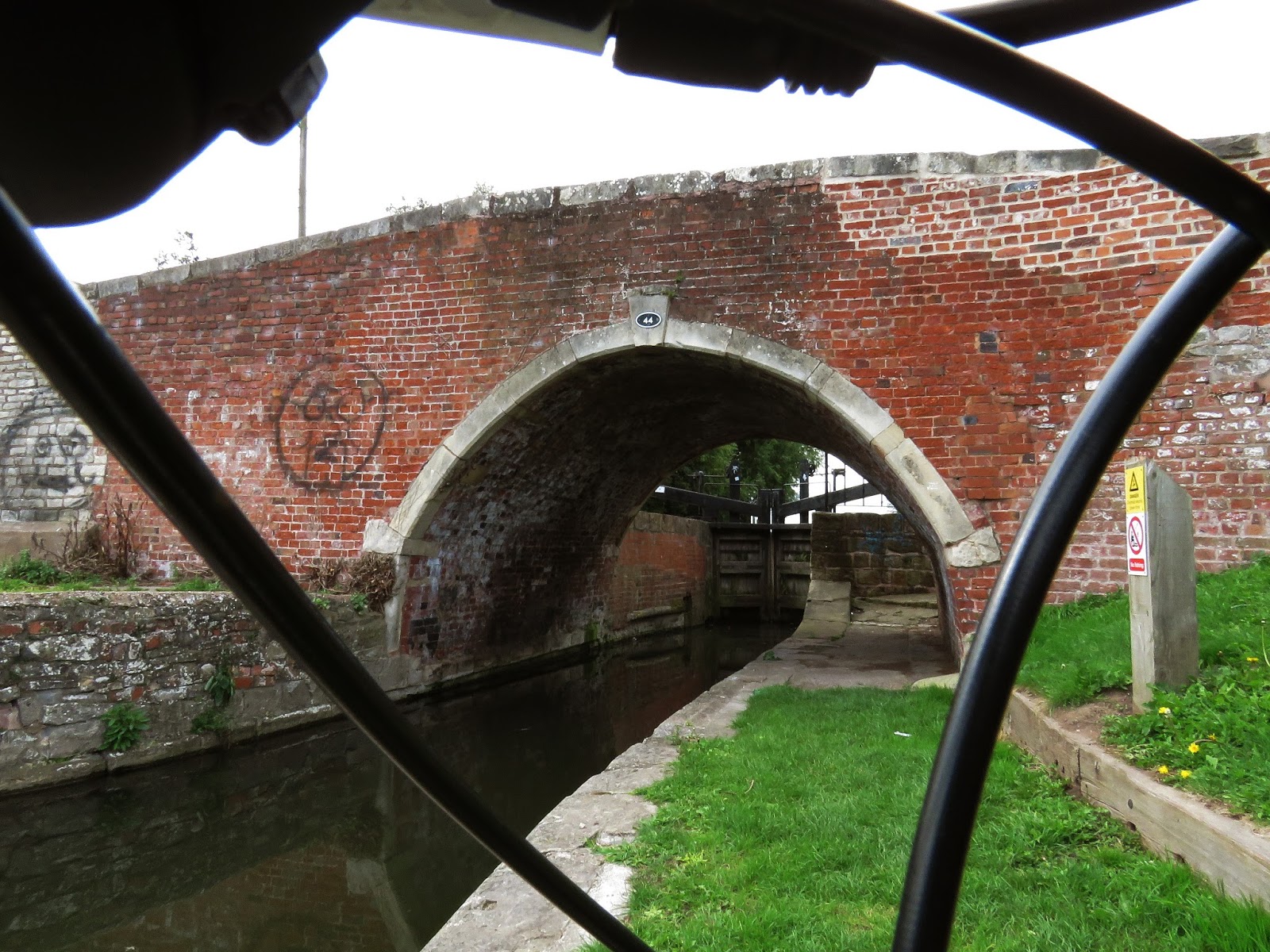
Bracebridge Bridge (no 44) traverses Kilton Top Lock across the Chesterfield Canal; built to link Chesterfield with the River Trent (to export coal, lead, timber and millstones and import wine, wool, fresh groceries, oil, rice and tobacco). The canal, (45.5 miles in length) is narrow and winding and horse drawn cuckoo boats had to be used (peculiar to this canal).
The factory was built at the time of a prosperous age and was still in use. The canal is being restored so looked as if I was approaching a more enterprising area of the town. Friedlander’s images of towns have buildings in which the perspective is uncorrected. I tried correcting the perspective by taking two images and layering one over the other; deciding the original was a more accurate representation of Friedlander’s work because the world is distorted from low down. I included the skid mark because it shows something happened here.
 |
| Image 11 |
The trail crossed a set of traffic lights and passed through another residential area which looked acceptable. Sandhill Lake (an old sandpit), my destination, backs onto this neighbourhood. As I reached here on my first journey, I heard domestic arguments and saw someone taking photos through the window of a flat. On my return visit, the flat was quiet and had been put up for rent suggesting that the people had moved out.
 |
| Image 12 |
Newspaper reports suggested a large sum of money had been spent on making this lake a destination for people to enjoy. In the afternoon sunshine it looked peaceful and tranquil. I felt this was a fitting return point for my journey.
Over a longer project, I could use different bikes for different landscapes – road bike for road shots and mountain bike for off road, hybrid for anything else. I don’t have mirrors on my bike but could purchase and fit to my hybrid, although this image would not fit in with the cycling enthusiasts in this country! However, with more time I could find a vintage bike and reflect on how the social landscape has changed. Instead I experimented with reflection in different ways such as the television shot and using shiny parts of the bike. In hindsight, I should have used a shop window in Worksop. I tried including my own shadow in reshoots which I felt did not produce a strong image although I did manage a self-portrait. Friedlander presents square images. My final submission is now landscape format because it suits the image. Again, in retrospect, I could try a square format. At the time of shooting I was unaware that my camera could be altered.
References
Barlow (2014) http://www.oxfordartonline.com/subscriber/article/grove/art/T029946?q=lee+friedlander&search=quick&pos=1&_start=1#firsthit
Esquire. (2011) Lee Friedlander by car. Esquire. 13th September. [online]. Available from: http://www.esquire.com/lifestyle/g635/lee-friedlander-america-by-car-photos/?slide=1 [last accessed 8th September 2016].
Farley, P. and Symmonds Roberts, M. (2011) Edgelands: Journeys into England's True Wilderness. London: Vintage.
O’Hagan, S. (2011) Lee Friedlander: America by car and the new cars 1964 – review. The Guardian. [online] 4/9/11. Available at:http://www.theguardian.com/artanddesign/2011/sep/04/lee-friedlander-photography-review [last accessed 21/07/2016].
Rosenburg, K. (2010) Landscapes framed by a chevy. The New York Times. [online] 2nd September. Available from:http://www.nytimes.com/2010/09/03/arts/design/03car.html?_r=0 [last accessed 9th September 2016].
Sustrans (n.d.) About us [online]. Website. Sustrans Available from: http://www.sustrans.org.uk/about-us [last accessed 21/07/16].
Bibliography
(Anon.) (n.d.) Part 4: 19th and 20th Century Worksop. [online] Worksop Heritage Trail.org.uk. [online] Available from:http://www.worksopheritagetrail.org.uk/resources/worksop_history_4.pdf [last accessed 21/07/16].
(Anon.) (2002) Clumber Park Nottinghamshire [online] Bassetlaw District Council. Available from:https://www.bassetlaw.gov.uk/media/66373/HistoricClumberPark.pdf [last accessed 21/07/15].
(Anon.) (2014) Worksop: Popular beauty spot Sandhill Lake to get a £100,000 makeover. Worksop Guardian [online]. 2nd April. Available from: http://www.worksopguardian.co.uk/news/local/worksop-popular-beauty-spot-sandhill-lake-to-get-a-100-000-makeover-1-6537514 [last accessed 21/07/16].
(Anon) (2015) BBC Weather [online] Website. Available from: http://www.bbc.co.uk/weather/2639687 [last accessed 21/07/15].
BBC Nottingham (2008) Local History Clumber Park Bridge. [online] Website. Available from:http://www.bbc.co.uk/nottingham/content/articles/2008/08/15/clumber_park_bridge_feature.shtml [last accessed 21/07/16].
Bradner, L. (2010) The Photo File: Lee Friedlander takes aim at the passing scenery. Los Angeles Times [online] 26/09/2010 Available from:http://articles.latimes.com/2010/sep/26/entertainment/la-ca-car-20100926 [last accessed 21/07/16].
Chesterfield Canal Trust. (n.d.) The Chesterfield Canal, a virtual tour. Part 5 Worksop to Retford. [online] Website. Available from:http://www.chesterfield-canal-trust.org.uk/virtualw.shtml [last accessed 21/07/16].
Friedlander, L. (2011) Lee Friedlander: America by Car in pictures. The Guardian. 2nd September. [online] Available from:https://www.youtube.com/watch?v=d9aK-DtsWw0by-car-in-pictures [last accessed 8/8/15]
Harding, C. (2013) The surprising link between cycling and photography [online]. Website. The National Media Museum. Available from:http://blog.nationalmediamuseum.org.uk/2013/07/23/cycling-and-photography/ [last accessed 21/07/16].
Henry Wessel: The view from the driver’s seat [user-generated content, online] Creat. San Fransisco Museum of Art. (2016) 1 min,54 secs. http://www.sfmoma.org/explore/multimedia/videos/295 [last accessed 21/07/16].
Nandi, T and R. (2012) History of Archway House, Sherwood Forest. [online] Website. Available from: http://www.archwayhouse-sherwood.co.uk/history.htm [accessed 21/07/16].
Nottinghamshire County Council (2013) New leisure trail opens between Bilsthorpe and Sherwood Pines [online] Nottinghamshire County Council. Website. Available from: http://www.nottinghamshire.gov.uk/pressreleases/show/new-leisure-trail-opens-between-bilsthorpe-and-sherwood-pines[last accessed 21/07/16].
Piebenga, S. (1994) William Sawrey Gilpin (1762-1843) Picturesque Improver. Garden History Vol 22 No 2 Winter 1994 [online] Available from:http://www.jstor.org/stable/1587026?seq=1#page_scan_tab_contents [last accessed 21/07/16].
Sustrans (n.d) Millennium Mileposts. [online] Website. Available from: http://www.sustrans.org.uk/scotland/national-cycle-network/about-network/millenium-mileposts [last accessed 21/07/16].
Symcox, J. (2015) Will Clipstone Colliery headstocks be saved? Community group plans 100mph zip line in ambitious regeneration plan. Mirror[online]. 2nd March. Available from: http://www.mirror.co.uk/news/uk-news/clipstone-colliery-headstocks-saved-community-4851729 [last accessed 21/07/16].
Taylor, T. (n.d.) Lee Friedlander: America by car and the new cars 1964 [online] Available from: http://timothytaylorgallery.com/exhibitions/lee-friedlander-america-by-car-the-new-cars-1964/info/ [last accessed 21/07/16].
Overall, my assignment was well received. It needs some fine tuning which will stand me in good stead for the critical review (assignment 4) and hopefully progressing onwards through level 5 towards 6.
"This is a thorough assignment submission Nicola with plenty of research, investigation and review. Your energetic interest in your project carries the reader/viewer along with you. I’m going to make several suggestions for development but that's because there’s enough here to work with, so please take it as a compliment and don’t forget to respond in your reflection on the tutor report." Tutor feedback Assignment 2 September 2015
Points for development
Bullet pointed from tutor comments:
- start with Friedlander's America by Car" as a contextual frame of reference" (tutor report) which is a bike ride through the landscape.
- Add in depth reflection of Friedlander's America by Car to my Assignment
- Consider illustrating with one of Friedlander's images (could link to his work on blog to avoid copyright issues)
- Short intro- places and dates etc
- Visual description of Friedlander's work (mention wide angle of SWC Hasselblad)
- Evidence some awareness of existing critical writing of Friedlander's series
- My response and how it relates to my work.
- Move my ideas, plans and parameters to "assignment prep" on blog
- Reshoot 3 images
"There’s a strong development through the series from the first shot of a bike in front of some graffiti to some really quite exciting images where we’re starting to feel a sense of being unstable, of flying through the landscape on this machine. For me this begins at number 3 with the obstructions right in our path, and continues on to 4 and 5 where the framing feels fresh and natural and speaks most directly to Friedlander’s work. In 6 you’re resting, which does drop the tempo of the viewing experience somewhat. It’s not a bad shot but I would like to find something more unexpected here, some subtle gesture of the body perhaps to express the idea. Then off again to Number 9 with the crazy telegraph pole and wires and no hands and then careering through 10 to a couple of more sedate images for 11 and 12." (Tutor report, September 2015).
I acknowledge the image of me map reading should perhaps be changed for one where there is momentum - in the form of an action shot. I had not considered it as breaking up the series or slowing it down. I explained in my notes that I was intending to use different parts of the bike in my images. This was to break away from what Friedlander had done so I did not feel like I was copying his idea. Friedlander uses a formula of images that work for him and I had not appreciated that by contextualising my ideas, my work could be similar without "copying". It will not be an issue to reshoot these to give the assignment a more "finished" feel. By sharing development work with a wider audience, I would get other points of view on how someone interprets a series. Having retaken 3 images, I see now that this works more cohesively as a series.
My tutor suggested that perhaps my journey worked as an imaginative one. I had not considered this idea although by the time I had finished reshooting, it was a representation rather than an actual journey. With my riding partner out of action through surgery, I spent a fair amount of time putting the bike in the back of the car and getting it back out again to reshoot, much to the amusement of several passing cyclists! Revisiting the quote I used in my blog on Marion Shoard's definition of Edgelands, I can see how this would give me a reason to portray an imaginary journey;”Edgelands are part of the gravitational field of all our larger urban areas, a texture we build up speed to escape as we hurry towards the English countryside, the distant wilderness.[…] If we can’t see the edgelands, we can’t imagine them, or allow them any kind of imaginative life. And so they don’t really exist.” Farley P, Symmonds Roberts, M (2011 p5)
Reference
Farley P, Symmonds Roberts, M (2011) Edgelands: Journeys into England's True Wilderness, Vintage
August 2015
Assignment 2: A journey
Journey ideas
- 20 mile bike ride through edgelands of Nottinghamshire (developed idea)
- edgelands walk through wilderness behind village. Rufford Colliery closed but used for coal washing. Bridleway and access changes periodically. Evidence of desire paths, people sleeping rough, territory, wires cut for access. Some developed into a nature reserve (SSSI) and golf course. (Edgelands, Topography)
- Based on work by Mark Power’s different endings (2003-6) looked at 14 A and B classification road endings and beginnings, visit industry or houses near to road junction build up image of Mansfield. Used google street view to plan a route. (Psychogeography)
- Park and Ride bus journey. Inspired by work from Nottingham Trent University degree show and Lee Friedlander’s work. Abandoned after walk for Exercise 2.5 Text in Art. Felt uninspired. (Edgelands, Topography)
Journey plan
Usual summer evening journey by bike to Clumber Park (owned by the National Trust) and back. Extending the route by 10 miles takes in the edgelands of Worksop; to examine human interaction in shifting landscapes. Land steeped in legend and folklore although not really touristic. Sustrans national trail 6 runs through area and plan to follow route from home to Worksop.
By photographing along a linear route and recording the planned images, the journey time would be 5 to 6 hours with stops to take photographs and cycling home in the dark. Have to reshoot if necessary.
First set of parameters:
· Use a bicycle. Interestingly, Niepce assisted with evolving the bicycle before photography developed as an art medium. Women took to riding bicycles with cameras attached to cases on the handlebars and cycling was promoted for photographers as a means of transport in the “Illustrated Photographer” in 1869.
· Take photos at every mile interval measured by cycle computer to ensure subject matter was systematically generated
· Take photograph at every number 6 signpost as record of landscape and looking for the signs enabled me to gain an understanding of the difficulties in following the route from a traveller’s perspective.
· Use bridge camera to enable me cover more distance quickly
· Photograph using similar viewpoints from bike. Shoot to side or forwards but not backwards because the journey should show where I was going. Experiment using handlebars in the frame.
The total number of photos taken on my first journey was 274! From this, I developed a contact sheet of 12 images and developed my images based around these locations.
Original 12 images

Development work
Lee Friedlander (America by Car 2010) presents 200 images taken on his journey through America. Using a documentary style of photography to record the topography of a social landscape taken through the car and by depicting parts of the car within the frame, he distorted the landscape and reflected some of his personality as a photographer into the image. He created his own world to take photographs from. Sometimes the door frame separates the image and occasionally he juxtaposes an object with part of the car’s interior. For example, he compares the foliage of the tree with the door panel material. He uses reflection in the mirrors to reveal a different landscape or a person (sometimes self-portrait). The limitations of using the car as a frame reveal buildings in which perspective is uncorrected that adds to the chaotic and trapped feeling. Friedlander’s images are cold and static, as if the outside world is being viewed from the inside comfort of the car.
Considering how to adapt this style of photography to include my bike as the vehicle, I deliberated using a gopro camera to take stills. Friedlander’s images were shot on film and can be produced to a reasonable size although pixelated gopro images could look like a modern interpretation. Better quality images with a camera I could manipulate outweighed the accessibility of the gopro; the only difficult shot to include being the front tyre view. However, working digitally, unlike Friedlander, several shots were possible to obtain the correct perspective of the bike in the landscape. Initially, I included only the handlebars, imagining I was sitting on a bike as opposed to being in a car; however, this was limiting and ordinary and I developed a style of showing many different views of the bike to intensify the dynamics. Using a low view point gave a fairly limiting view which I felt was similar to Friedlander’s idea.
Henry Wessel, explained that he started taking images whilst driving around in his car. Once he stepped out of his vehicle and explored the area, he discovered the landscape was radically different. I associate with this as when using Google street view and the OS map to research my route, although some of the images looked similar to google, the detail and the atmosphere of the housing estates in Worksop were much rougher than perceived. Some google street view images had not been updated since 2009 although nearby was updated in 2014.
Toby Smith (Walk the HS2 line project) presented a session at the Photography Show NEC this year. This large scale project walking London to Birmingham (140 miles in 10 weeks) documented the current social landscapes such as derelict buildings, personal graffiti or converted buildings and people’s livelihoods which could be affected with the HS2 line. He spoke of the importance of selecting parameters when faced with a large scale project. I set some parameters and when reshooting found that if the original situation had changed, I could go back to the previous mile marker (one of my parameters) to illustrate a different scene. Toby’s images were colour, shot in film and square (like Friedlander’s) which complemented the composition. As a series of images, the lighting, weather and seasons changed over the period of time. I re-shot in the afternoon so my images were still in time order with it being a small journey. He suggested always using a tripod to give good quality images, although in this situation the tripod legs would have been inconvenient. However, to maintain a good quality of image, I set the shutter speed to 1/125s so that camera shake was not present. In hindsight, maybe a gorilla pod attached to the bike would work.
The journey
The journey began at 4:30pm on a beautiful sunny, warm afternoon. The sort which kept the insects high, brings out the scent of the wayside plants and trees and gives everything an orange tint, reminiscent of the colours in a romantic Victorian landscape painting. The clouds added texture to the sky. My bag was packed with the essentials – lights, first aid kit, puncture repair kit and bike spares, snack bars, extra drinks, a jersey, riding glasses, a Landranger Ordnance Survey map, phone, loose change and a bridge camera complete with spare battery, memory card, lens cloth and waterproof bag in case of the rain shower which did not appear on the BBC weather app.
The first mile took me through different housing estates in the village and onto an old railway line (originally owned by the Great Central Railway) and ran between 2 collieries, with a tarmac surface where a few teenagers hang out and the rider often meets dogs off leads, changing graffiti on the bridge and desire paths people make as they take the shortest route up and down the unstable banks rather than use the gently sloping path. Now owned by Sustrans, a UK charity who enable “people to travel by foot, bike or public transport for more of the journeys we make every day.”http://www.sustrans.org.uk/about-us (accessed 4/8/15)
 |
| Image 1 |
The sunlight on the yellow and blue paint provided a good contrast to the bike. The curves of the cables complemented the curves on the graffiti. I explored various angles and bike parts against the wall and felt this created a strong image. As a first image, I aimed to show the mode of transport and give the viewer a sense that it was not a journey through a “picturesque” part of the country. “Graffiti is part of the visual noise of our age, in the same way as broadsheet ballads once supplied the background buzz of earlier centuries, and is perfect for the mobile gaze; the short emphatic, florid statement of name, protest or allegiance, an impression meant to be made at high speed.” Farley, P Roberts Symmonds M (2011, p124) Over time, the graffiti on these bridges are painted over and repainted with different names or artwork or left to fade as people move on.
 |
| Image 2 |
Over time, sections of the railway have been moved and other tracks added. I found the idea of “desire paths” or paths of least resistance an interesting concept of planners versus people in developing the landscape. Farley P and Symmonds Roberts M (2011 p24) explain this as a “”bottom up” system against the “top down” methodology of the planners.” Walking this area always reminds me of how rights of way have evolved.
The track turned alongside Rainworth Water on one side and Rufford Colliery workings on the other. Great care is taken to keep the public out and deter would be adventurers with wire (often cut) and trees strategically placed across the track to prevent the cyclist from straying onto the pit land.
After a couple of miles on land owned by the Forestry Commission, (Sherwood Pines) my journey took me across Eakring Road; a sandy road, impassable by cars and now lined by large rocks in places to keep out the notorious abandoned, torched cars. It does still hold surprises – Sat Nav’s send the unknowing holiday makers along this road to Centre Parcs! Over the years, steel barriers have been removed by opportunist scrap metal merchants and again, the barrier is now large rocks.
 |
| Image 3 |
This was photographed with my bike turned round and looking back at my journey as the view was more descriptive. Does it matter that it is not a truthful representation? I think not because if I was marketing the image for the Forestry Commission, I would argue that it is more “picturesque” than looking the other way.
The view of Vicar Water Country Park is dominated by the colliery headstocks (the tallest in Europe) – a listed building which locals are fighting to save from demolition. These are a prominent view in the area. The pond dates from the Victorian times and sits in the middle of colliery spoil heaps which have been turned into a country park. It is popular with many different users; walkers, cyclists, horse riders and fishermen.
 |
| Image 4 |
In the original image, I had captured a horse and cart against a sign for multi - users (bikes, pedestrians and horses). During the reshoot, I saw several pedestrians and cyclists. By framing the towers between the cables, I aimed to make the headstock towers the focal point and show trail user on the periphery of the image, similar to Friedlander’s framing with the windscreen and side window.
The track passes the edge of Clipstone Colliery and into rural countryside, past a pub, across a set of traffic lights and through the grounds of Archway House, formerly a hunting lodge and now a self-catering cottage. Originally built by the 4th Duke of Portland in 1842, it was a copy of the gatehouse at Worksop Priory. Being situated in the heart of Sherwood Forest, it is decorated with statues of Robin Hood, Little John, Maid Marion, King Richard, Friar Tuck and Alan a Dale. This was positioned on the old Broad Drive so a view of the centre tree was visible through the middle of the building.
 |
| Image 5 |
The frame of the bike lends itself to the shape of the building, as if creating a frame for the image. The children’s slide repeats the shape of the bike frame.
Passing public art in the form of a sculptured millennium mile post marker on the Sustrans trail, the cyclist is reminded how far they have come and still have to go. Designed by Andrew Rowe, a Welsh Artist, it is “based on the nautical and industrial heritage of his native Swansea.” (http://www.sustrans.org.uk/scotland/national-cycle-network/about-network/millenium-mileposts accessed 4/8/15) Sustrans highlight that it is one of four available (designed by an English, Scottish, Welsh and Northern Ireland sculptor) and developers of tracks tend to favour those from their own country of origin. I had already passed another Welsh statue at Clipstone and there is a record of another Welsh marker further along my journey, so with 3 Welsh mile marker posts within 15 miles, I have to disagree with the comment from Sustrans.
 |
| Image 6 |
Friedlander included self-portraits through his car window or in the mirror. I included a long shot across the bike showing the map with mile markers highlighted.
For those who wish to enter the National Trust’s Clumber Park grounds without their car, a carpark is located on the main road out of Worksop. Cyclists and walkers use the Sustrans track to enjoy the ducal park or carry on to Lincoln via a link to the number 6 trail. This seat is less than half a mile from the carpark and I am amazed at how much litter accumulates in the summer. There are no bins, but neither are there any “please take your litter home” signs. However, when I came to reshoot this image, the original litter had been cleared and someone had left a bottle on the bench.
 |
| Image 7 |
This view, taken through the suspension forks is similar to Friedlander’s division through the windscreen. On one hand there is a scenic view down the track and on the other is the bench with litter.
The track eventually joins a tarmac road and heads downhill, past a monkey tree and over a classical bridge built in the 1760’s which is under threat from cars driving into the balustrades and subsidence from the mines which run underneath it. Travelling through the park and following the signs, I saw Truman’s lodge in the distance, an entrance to the park built in 1789. I was surprised to learn that the formal gardens of Clumber Park were designed by William Sawrey Gilpin, nephew of William Gilpin who turned from landscape painting to landscape gardening in later life.
 |
| Image 8 |
The track turned just before the lodge, meaning I only caught a glimpse of it in the distance. It traversed through the undergrowth, past another Welsh millennium mile post (Dover 504 miles – Inverness 780 miles) and out past a golf course. Once we joined the tarmac road towards Worksop, the scenery became more edgelands and then urban. The track turned again, this time running past the club house, where some golfers stopped to ask me what I was up to. They were quite interested in my journey.
This was the first lighting and litter bin I had come across in 17 miles; however, there was very little litter around. Maybe the addition of a dog bin would have helped the condition of the path. Friedlander uses strong shadows in his work; the weather conditions produced the shadows and I experimented here with including a shadow of the bike although it did not have the desired impact.
In suburbia, the signposting became confusing as it was stickers or signs on lampposts and bus stops. The tarmac road surface meant I could travel faster but also had to avoid parked cars, kids playing in the streets and families drinking beer on their sofas in the front gardens. Allowing for some distortion due to the shooting angle, I re-examined the telegraph pole and it really is bent.
 |
| Image 9 |
I passed the Manton Colliery wheel sculpture, and the route headed towards the Chesterfield Canal with its industrial heritage. The dog walkers I met were very friendly, and the towpath soon gave way to a road and industrial units. This bin is very close to the road and people have dumped an assortment of rubbish including a television next to it.
 |
| Image 10 |
I experimented with several images to include a reflection in the television which was not successful! Instead, a view looking back at the rubbish worked as a reflection of the environment I was leaving behind.
The factory was built at the time of a prosperous age and was still in use. The canal is being restored so looked as if I was approaching a more enterprising area of the town. However, on the other side of the road were inebriated locals.
 |
| Image 11 |
Friedlander’s images of towns have buildings in which the perspective is uncorrected. I tried correcting the perspective by taking two images and layering one over the other; deciding the original was a more accurate representation of Friedlander’s work because the world is distorted from low down. I included the skid mark because it shows something happened here.
The trail crossed a set of traffic lights and passed through another residential area which looked acceptable. Sandhill Lake (an old sandpit), my destination, backs onto this neighbourhood. As I reached here on my first journey, I heard domestic arguments and saw someone taking photos through the window of a flat. On my return visit, the flat was quiet and had been put up for rent suggesting that the people had moved out.
 |
| Image 12 |
Newspaper reports suggested a large sum of money had been spent on making this lake a destination for people to enjoy. In the afternoon sunshine it looked peaceful and tranquil. I felt this was a fitting return point for my journey.
Over a longer project, I could use different bikes for different landscapes – road bike for road shots and mountain bike for off road, hybrid for anything else. I don’t have mirrors on my bike but could purchase and fit to my hybrid, although this image would not fit in with the cycling enthusiasts in this country! However, with more time I could find a vintage bike and reflect on how the social landscape has changed. Instead I experimented with reflection in different ways such as the television shot and using shiny parts of the bike. In hindsight, I should have used a shop window in Worksop. I tried including my own shadow in reshoots which I felt did not produce a strong image although I did manage a self-portrait. Friedlander presents square images. My final submission is now landscape format because it suits the image. Again, in retrospect, I could try a square format. At the time of shooting I was unaware that my camera could be altered.
So how should I present my images? One of the elements of “The Journey” project is land art. Whilst the work of Richard Long, Ian Brown and Liz Nichol interested me, it did not excite me enough to experiment much. I kept a list of words to include; however most of these were included in explaining the journey.
David Campany explains that the disadvantage of a photobook (catalogue, archive) is that the individual images grouped together describe but do not communicate on their own. "Visual facts don't speak very well for themselves." (http://davidcampany.com/almost-the-same-thing-some-thoughts-on-the-photographer-as-collector/ accessed 29/6/15) Campany cites Walker Evans as saying "a document has use, whereas art is really useless." (http://davidcampany.com/almost-the-same-thing-some-thoughts-on-the-photographer-as-collector/ accessed 29/6/15) So without words, my photos may not work in a photobook.
The Bechers' placed their images centrally in the frame and then joined several frames together to create a montage which works because the brain prefers to look at contrast, differences, comparison, dialogue between the images, repetition etc. So the viewer looked at the work twice - once as a stand-alone image and then as a montage.
Emily Allchurch takes paintings from landscape painters such as Joachim Patinir (1480-1524) or Pieter Bruegel (1529-69) and makes a unique photo montage from individual images taken on her mobile phone or camera, updating the original painting to represent the 21st century. Recently she invited residents of Nottingham to help create a “Tower of Babel” image using local landmarks and mediums such as photography and drawing. Her images are huge and takes visitors time to pull out interesting features within the image. Taking inspiration from Allchurch’s image “Worldscape” (2008) based on Patinir’s Temptation of St Anthony (1520-24), I created a montage of my journey, showing a path in the middle, countryside on the left and industry on the right. A bridge is often used as a metaphor for linking the past, so this appears at the bottom of the image. In the distance is the twin headstocks, which tower above the landscape. All the elements of the journey are represented and although it lacks in technical skill, I felt it was creative. My learning point from creating this retrospectively using images taken on my journey was that images did not fitted together cohesively. Allchurch’s solution to this is careful planning with selection of her images. The viewer is able to look at elements of the journey in one single image, thus looking at the journey for longer.

References
http://www.sustrans.org.uk/about-us (accessed 4/8/15)
Farley, P Roberts Symmonds M (2011, p124) Edgelands journeys into England’s true wilderness, Vintage
Farley, P Roberts Symmonds M (2011, p24) Edgelands journeys into England’s true wilderness, Vintage
http://davidcampany.com/almost-the-same-thing-some-thoughts-on-the-photographer-as-collector/ accessed 29/6/15
http://davidcampany.com/almost-the-same-thing-some-thoughts-on-the-photographer-as-collector/ accessed 29/6/15
Bibliography
Farley, P Roberts Symmonds M (2011, p124) Edgelands journeys into England’s true wilderness, Vintage
http://www.theguardian.com/artanddesign/gallery/2011/sep/02/lee-friedlander-america- accessed 8/8/15
https://www.youtube.com/watch?v=d9aK-DtsWw0by-car-in-pictures accessed 8/8/15
http://www.sfmoma.org/explore/multimedia/videos/295 accessed 8/8/15
http://www.tobysmith.com/project/high-speed-2-overview/ accessed 8/8/15
www.beardsmoregallery.com/exhibitions/walking-the-land/ accessed 21/07/2015
www.richardlong.org accessed 21/07/15
http://www.nottinghamshire.gov.uk/pressreleases/show/new-leisure-trail-opens-between-bilsthorpe-and-sherwood-pines accessed 21/07/15
http://www.archwayhouse-sherwood.co.uk/history.htm accessed 21/07/15
http://www.sustrans.org.uk/scotland/national-cycle-network/about-network/millenium-mileposts accessed 21/07/15
http://www.bbc.co.uk/nottingham/content/articles/2008/08/15/clumber_park_bridge_feature.shtml accessed 21/07/15
https://www.bassetlaw.gov.uk/media/66373/HistoricClumberPark.pdf accessed 21/07/15
http://www.jstor.org/stable/1587026?seq=1#page_scan_tab_contents (Gilpin) accessed 21/07/15
http://www.mirror.co.uk/news/uk-news/clipstone-colliery-headstocks-saved-community-4851729 accessed 21/07/15
http://www.chesterfield-canal-trust.org.uk/virtualw.shtml accessed 21/07/15
http://www.worksopguardian.co.uk/news/local/worksop-popular-beauty-spot-sandhill-lake-to-get-a-100-000-makeover-1-6537514 accessed 21/07/15
http://www.bbc.co.uk/weather/2639687 accessed 21/07/15
http://www.sustrans.org.uk/about-us (accessed 4/8/15)
http://davidcampany.com/almost-the-same-thing-some-thoughts-on-the-photographer-as-collector/ accessed 29/6/15


